The Element Nitrogen Can Be Found Only in:
Abstract
Nitrogen, the most arable chemical element in our temper, is crucial to life. Nitrogen is found in soils and plants, in the h2o we drink, and in the air we exhale. It is as well essential to life: a primal building block of DNA, which determines our genetics, is essential to plant growth, and therefore necessary for the nutrient we grow. Merely as with everything, balance is key: as well little nitrogen and plants cannot thrive, leading to depression crop yields; only too much nitrogen tin can exist toxic to plants, and tin can likewise harm our surround. Plants that do not have enough nitrogen go yellowish and do not grow well and can have smaller flowers and fruits. Farmers can add nitrogen fertilizer to produce better crops, but as well much can hurt plants and animals, and pollute our aquatic systems. Understanding the Nitrogen Cycle—how nitrogen moves from the atmosphere to earth, through soils and back to the atmosphere in an endless Cycle—tin can help us grow healthy crops and protect our environment.
Introduction
Nitrogen, or N, using its scientific abbreviation, is a colorless, odorless element. Nitrogen is in the soil nether our feet, in the water nosotros potable, and in the air nosotros breathe. In fact, nitrogen is the virtually abundant chemical element in Earth's atmosphere: approximately 78% of the atmosphere is nitrogen! Nitrogen is important to all living things, including us. It plays a primal role in plant growth: besides little nitrogen and plants cannot thrive, leading to low crop yields; but too much nitrogen can exist toxic to plants [1]. Nitrogen is necessary for our food supply, simply excess nitrogen can harm the environment.
Why Is Nitrogen Of import?
The delicate balance of substances that is important for maintaining life is an of import surface area of research, and the remainder of nitrogen in the environment is no exception [two]. When plants lack nitrogen, they become yellowed, with stunted growth, and produce smaller fruits and flowers. Farmers may add together fertilizers containing nitrogen to their crops, to increment crop growth. Without nitrogen fertilizers, scientists judge that we would lose up to one third of the crops we rely on for food and other types of agronomics. Merely we demand to know how much nitrogen is necessary for plant growth, because too much can pollute waterways, hurting aquatic life.
Nitrogen Is Key to Life!
Nitrogen is a key element in the nucleic acids DNA and RNA , which are the most important of all biological molecules and crucial for all living things. Dna carries the genetic information, which ways the instructions for how to make upwards a life class. When plants do not go enough nitrogen, they are unable to produce amino acids (substances that contain nitrogen and hydrogen and brand upward many of living cells, muscles and tissue). Without amino acids, plants cannot make the special proteins that the plant cells need to grow. Without enough nitrogen, found growth is afflicted negatively. With too much nitrogen, plants produce backlog biomass, or organic thing, such as stalks and leaves, but non enough root structure. In extreme cases, plants with very high levels of nitrogen captivated from soils tin poison farm animals that eat them [iii].
What Is Eutrophication and tin can It Exist Prevented?
Excess nitrogen tin also leach—or bleed—from the soil into underground h2o sources, or it can enter aquatic systems as above ground runoff. This backlog nitrogen can build upwardly, leading to a procedure called eutrophication . Eutrophication happens when too much nitrogen enriches the water, causing excessive growth of plants and algae. Also much nitrogen can even cause a lake to turn bright light-green or other colors, with a "bloom" of evil-smelling algae chosen phytoplankton (see Figure 1)! When the phytoplankton dies, microbes in the water decompose them. The procedure of decomposition reduces the amount of dissolved oxygen in the water, and tin pb to a "dead zone" that does not accept enough oxygen to support most life forms. Organisms in the dead zone die from lack of oxygen. These expressionless zones tin can happen in freshwater lakes and also in coastal environments where rivers full of nutrients from agronomical runoff (fertilizer overflow) menstruation into oceans [four].
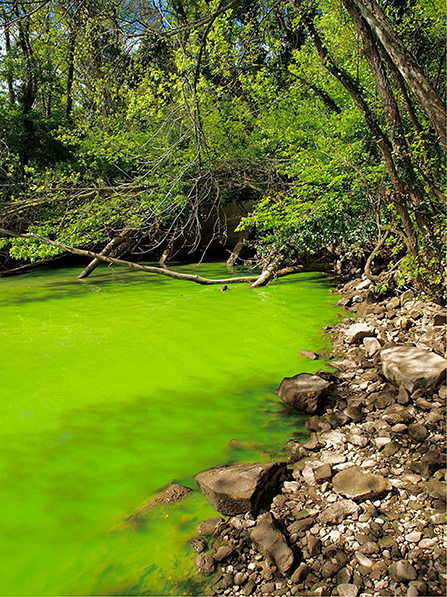
- Effigy one - Eutrophication at a waste water outlet in the Potomac River, Washington, D.C.
- The h2o in this river, is bright dark-green considering information technology has undergone eutrophication, due to excess nitrogen and other nutrients polluting the water, which has led to increased phytoplankton and algal blooms, so the water has become cloudy and can turn different colors, such equally green, yellowish, ruby, or chocolate-brown, depending on the algal blooms (Wikimedia Commons: https://eatables.wikimedia.org/wiki/Category:Eutrophication#/media/File:Potomac_green_water.JPG).
Figure 2 shows the stages of Eutrophication (open up access Wikimedia Eatables paradigm from https://eatables.thousand.wikimedia.org/wiki/File:Eutrophicationmodel.svg).
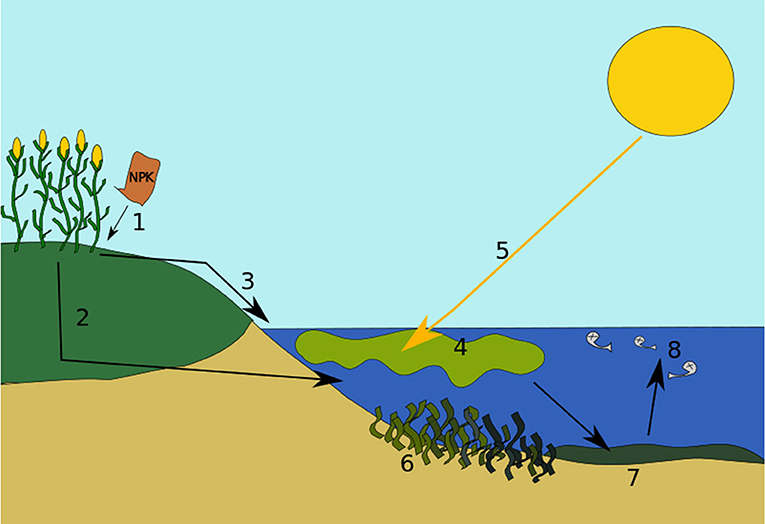
- Effigy 2 - Stages of eutrophication.
- (one) Backlog nutrients end up in the soil and ground. (2) Some nutrients become dissolved in water and leach or leak into deeper soil layers. Eventually, they go tuckered into a h2o body, such as a lake or pond. (3) Some nutrients run off from over the soils and ground directly into the water. (4) The extra nutrients cause algae to bloom. (five) Sunlight becomes blocked by the algae. (6) Photosynthesis and growth of plants under the water volition be weakened or potentially stopped. (7) Next, the algae bloom dies and falls to the lesser of the water body. Then, bacteria begin to decompose or pause up the remains, and apply up oxygen in the procedure. (8) The decomposition process causes the water to have reduced oxygen, leading to "dead zones." Bigger life forms like fish cannot breathe and die. The water body has now undergone eutrophication.
Can eutrophication be prevented? Yes! People who manage water resources can use unlike strategies to reduce the harmful effects of algal blooms and eutrophication of water surfaces. They tin can re-reroute excess nutrients away from lakes and vulnerable costal zones, use herbicides (chemicals used to kill unwanted constitute growth) or algaecides (chemicals used to kill algae) to stop the algal blooms, and reduce the quantities or combinations of nutrients used in agricultural fertilizers, among other techniques [5]. But, it can often exist hard to find the origin of the backlog nitrogen and other nutrients.
In one case a lake has undergone eutrophication, information technology is fifty-fifty harder to practice damage control. Algaecides can be expensive, and they also do not correct the source of the problem: the backlog nitrogen or other nutrients that acquired the algae bloom in the first identify! Another potential solution is chosen bioremediation , which is the procedure of purposefully changing the nutrient spider web in an aquatic ecosystem to reduce or control the corporeality of phytoplankton. For example, h2o managers tin introduce organisms that eat phytoplankton, and these organisms tin help reduce the amounts of phytoplankton, by eating them!
What Exactly Is the Nitrogen Cycle?
The nitrogen cycle is a repeating bicycle of processes during which nitrogen moves through both living and non-living things: the atmosphere, soil, water, plants, animals and bacteria . In order to motility through the different parts of the cycle, nitrogen must change forms. In the temper, nitrogen exists as a gas (Northward2), simply in the soils it exists equally nitrogen oxide, NO, and nitrogen dioxide, NO2, and when used as a fertilizer, tin can be found in other forms, such equally ammonia, NH3, which tin can be candy even farther into a different fertilizer, ammonium nitrate, or NH4NOiii.
In that location are five stages in the nitrogen cycle, and nosotros will at present talk over each of them in plow: fixation or volatilization, mineralization, nitrification, immobilization, and denitrification. In this image, microbes in the soil turn nitrogen gas (Northward2) into what is called volatile ammonia (NH3), so the fixation procedure is called volatilization. Leaching is where sure forms of nitrogen (such as nitrate, or NO3) becomes dissolved in water and leaks out of the soil, potentially polluting waterways.
Stage ane: Nitrogen Fixation
In this stage, nitrogen moves from the atmosphere into the soil. Globe'southward temper contains a huge pool of nitrogen gas (N2). Just this nitrogen is "unavailable" to plants, because the gaseous grade cannot be used directly by plants without undergoing a transformation. To be used by plants, the Ntwo must be transformed through a process chosen nitrogen fixation. Fixation converts nitrogen in the atmosphere into forms that plants tin blot through their root systems.
A minor corporeality of nitrogen can be fixed when lightning provides the free energy needed for North2 to react with oxygen, producing nitrogen oxide, NO, and nitrogen dioxide, NO2. These forms of nitrogen and then enter soils through pelting or snow. Nitrogen can also be stock-still through the industrial process that creates fertilizer. This form of fixing occurs under high rut and pressure level, during which atmospheric nitrogen and hydrogen are combined to form ammonia (NH3), which may then exist processed further, to produce ammonium nitrate (NH4NO3), a course of nitrogen that can be added to soils and used by plants.
Most nitrogen fixation occurs naturally, in the soil, by bacteria. In Figure 3 (above), you tin can encounter nitrogen fixation and commutation of form occurring in the soil. Some leaner attach to establish roots and have a symbiotic (beneficial for both the plant and the bacteria) relationship with the plant [6]. The leaner get energy through photosynthesis and, in return, they fix nitrogen into a form the constitute needs. The fixed nitrogen is then carried to other parts of the plant and is used to grade institute tissues, so the institute can grow. Other bacteria live freely in soils or h2o and tin fix nitrogen without this symbiotic relationship. These bacteria can as well create forms of nitrogen that can be used by organisms.
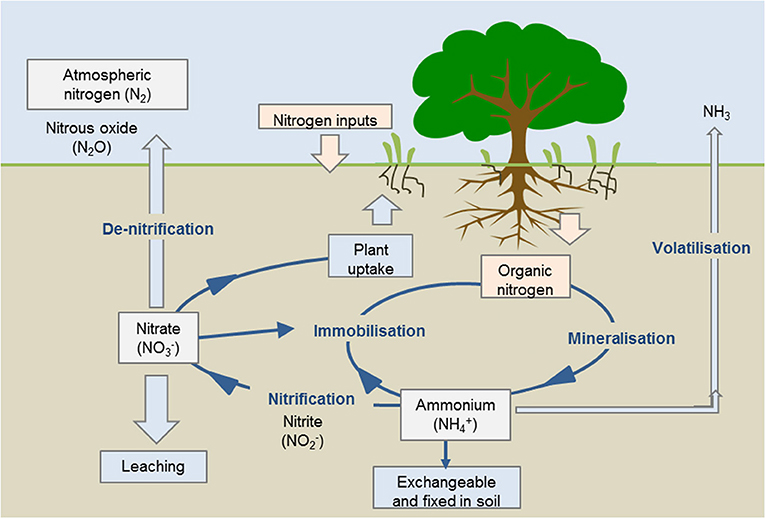
- Figure 3 - Stages of the nitrogen bicycle.
- The Nitrogen Bike: Nitrogen cycling through the various forms in soil determines the corporeality of nitrogen available for plants to uptake. Source: https://www.agric.wa.gov.au/soil-carbon/immobilisation-soil-nitrogen-heavy-stubble-loads.
Stage ii: Mineralization
This phase takes place in the soil. Nitrogen moves from organic materials, such as manure or plant materials to an inorganic form of nitrogen that plants can utilize. Eventually, the institute's nutrients are used up and the plant dies and decomposes. This becomes important in the second stage of the nitrogen cycle. Mineralization happens when microbes human action on organic material, such as animate being manure or decomposing plant or brute fabric and begin to convert it to a form of nitrogen that can be used by plants. All plants under cultivation, except legumes (plants with seed pods that split in half, such as lentils, beans, peas or peanuts) get the nitrogen they require through the soil. Legumes get nitrogen through fixation that occurs in their root nodules, every bit described above.
The first form of nitrogen produced by the process of mineralization is ammonia, NHthree. The NH3 in the soil and then reacts with h2o to form ammonium, NH4. This ammonium is held in the soils and is available for use by plants that do not get nitrogen through the symbiotic nitrogen fixing relationship described above.
Phase 3: Nitrification
The third phase, nitrification, as well occurs in soils. During nitrification the ammonia in the soils, produced during mineralization, is converted into compounds called nitrites, NO2 −, and nitrates, NO3 −. Nitrates tin can be used by plants and animals that swallow the plants. Some bacteria in the soil tin turn ammonia into nitrites. Although nitrite is not usable by plants and animals directly, other bacteria can change nitrites into nitrates—a form that is usable by plants and animals. This reaction provides energy for the bacteria engaged in this process. The leaner that we are talking about are called nitrosomonas and nitrobacter. Nitrobacter turns nitrites into nitrates; nitrosomonas transform ammonia to nitrites. Both kinds of bacteria can act only in the presence of oxygen, Otwo [vii]. The process of nitrification is important to plants, every bit information technology produces an extra stash of available nitrogen that tin can be absorbed by the plants through their root systems.
Stage 4: Immobilization
The quaternary phase of the nitrogen cycle is immobilization, sometimes described every bit the contrary of mineralization. These two processes together control the amount of nitrogen in soils. Simply like plants, microorganisms living in the soil crave nitrogen as an energy source. These soil microorganisms pull nitrogen from the soil when the residues of decomposing plants practice not contain enough nitrogen. When microorganisms have in ammonium (NH4 +) and nitrate (NO3 −), these forms of nitrogen are no longer available to the plants and may cause nitrogen deficiency, or a lack of nitrogen. Immobilization, therefore, ties up nitrogen in microorganisms. However, immobilization is of import considering it helps control and balance the amount of nitrogen in the soils past tying it up, or immobilizing the nitrogen, in microorganisms.
Stage 5: Denitrification
In the fifth phase of the nitrogen cycle, nitrogen returns to the air as nitrates are converted to atmospheric nitrogen (Nii) past bacteria through the process we call denitrification. This results in an overall loss of nitrogen from soils, equally the gaseous grade of nitrogen moves into the atmosphere, back where we began our story.
Nitrogen Is Crucial for Life
The cycling of nitrogen through the ecosystem is crucial for maintaining productive and healthy ecosystems with neither too much nor too petty nitrogen. Establish production and biomass (living fabric) are limited by the availability of nitrogen. Understanding how the establish-soil nitrogen cycle works can assist us brand better decisions about what crops to grow and where to abound them, so we have an adequate supply of food. Knowledge of the nitrogen bicycle can also help us reduce pollution acquired by adding also much fertilizer to soils. Certain plants can uptake more nitrogen or other nutrients, such as phosphorous, some other fertilizer, and can even be used as a "buffer," or filter, to prevent excessive fertilizer from inbound waterways. For example, a written report done by Haycock and Pinay [8] showed that poplar trees (Populus italica) used as a buffer held on to 99% of the nitrate entering the underground water flow during winter, while a riverbank zone covered with a specific grass (Lolium perenne L.) held up to 84% of the nitrate, preventing it from entering the river.
Every bit you have seen, not enough nitrogen in the soils leaves plants hungry, while also much of a practiced matter can exist bad: excess nitrogen can toxicant plants and even livestock! Pollution of our h2o sources by surplus nitrogen and other nutrients is a huge problem, as marine life is beingness suffocated from decomposition of expressionless algae blooms. Farmers and communities demand to work to improve the uptake of added nutrients by crops and care for animal manure waste properly. We also need to protect the natural plant buffer zones that can take upwardly nitrogen runoff before it reaches water bodies. Only, our current patterns of immigration trees to build roads and other construction worsen this problem, because there are fewer plants left to uptake excess nutrients. We need to do further enquiry to make up one's mind which institute species are best to grow in coastal areas to accept up backlog nitrogen. We too need to find other ways to gear up or avert the problem of backlog nitrogen spilling over into aquatic ecosystems. Past working toward a more complete understanding of the nitrogen cycle and other cycles at play in Earth's interconnected natural systems, we can better understand how to better protect Earth's precious natural resource.
Glossary
DNA: ↑ Deoxyribonucleic acid, a self-replicating fabric which is nowadays in nigh all living organisms every bit the master component of chromosomes, and carrier of genetic information.
RNA: ↑ Ribonucleic acid, a nucleic acid nowadays in all living cells, acts every bit a messenger carrying instructions from Dna.
Eutrophication: ↑ Excessive amount of nutrients (such as nitrogen) in a lake or other trunk of water, which causes a dense growth of aquatic plant life, such as algae.
Phytoplankton: ↑ Tiny, microscopic marine algae (also known equally microalgae) that require sunlight in order to grow.
Bioremediation: ↑ Using other microorganisms or tiny living creatures to eat and break down pollution in club to clean a polluted site.
Bacteria: ↑ Microscopic living organisms that usually incorporate only one prison cell and are institute everywhere. Bacteria tin cause decomposition or breaking downward, of organic material in soils.
Leaching: ↑ When a mineral or chemical (such as nitrate, or NOiii) drains away from soil or other ground textile and leaks into surrounding area.
Legumes: ↑ A member of the pea family unit: beans, lentils, soybeans, peanuts and peas, are plants with seed pods that split up in half.
Microorganism: ↑ An organism, or living thing, that is too tiny to be seen without a microscope, such equally a bacterium.
Disharmonize of Interest Statement
The author declares that the enquiry was conducted in the absence of any commercial or financial relationships that could exist construed as a potential disharmonize of involvement.
References
[1] ↑ Britto, D. T., and Kronzuker, H. J. 2002. NH4 + toxicity in higher plants: a critical review. J. Plant Physiol. 159:567–84. doi: x.1078/0176-1617-0774
[ii] ↑ Weathers, K. C., Groffman, P. G., Dolah, East. V., Bernhardt, E., Grimm, Due north. B., McMahon, K., et al. 2016. Frontiers in ecosystem ecology from a community perspective: the future is boundless and bright. Ecosystems 19:753–70. doi: 10.1007/s10021-016-9967-0
[iii] ↑ Brady, N., and Weil, R. 2010. "Nutrient cycles and soil fertility," in Elements of the Nature and Properties of Soils, 3rd Edn, ed V. R. Anthony (Upper Saddle River, NJ: Pearson Educational activity Inc.), 396–420.
[iv] ↑ Foth, H. 1990. Chapter 12: "Plant-Soil Macronutrient Relations," in Fundamentals of Soil Science, eighth Edn, ed John Wiley and Sons (New York, NY: John Wiley Company), 186–209.
[five] ↑ Chislock, M. F., Doster, E., Zitomer, R. A., and Wilson, A. E. 2013. Eutrophication: causes, consequences, and controls in aquatic ecosystems. Nat. Educ. Knowl. four:10. Bachelor online at: https://www.nature.com/scitable/knowledge/library/eutrophication-causes-consequences-and-controls-in-aquatic-102364466
[half dozen] ↑ Peoples, M. B., Herridge, D. F., and Ladha, J. G. 1995. Biological nitrogen fixation: an efficient source of nitrogen for sustainable agricultural production? Plant Soil 174:iii–28. doi: ten.1007/BF00032239
[7] ↑ Manahan, S. E. 2010. Environmental Chemistry, 9th Edn. Boca Raton, FL: CRC Press, 166–72.
[8] ↑ Haycock, N. Due east., and Pinay, G. 1993. Groundwater nitrate dynamics in grass and poplar vegetated riparian buffer strips during the wintertime. J. Environ. Qual. 22:273–eight. doi: 10.2134/jeq1993.00472425002200020007x
Source: https://kids.frontiersin.org/articles/10.3389/frym.2019.00041

Post a Comment for "The Element Nitrogen Can Be Found Only in:"